Why Most Crypto Never Crosses Over
More than half of every token ever created is already dead. The point of failure is rarely the idea. It is the gap between a launch and durable institutional adoption, and the two engineered systems that decide which projects survive it.
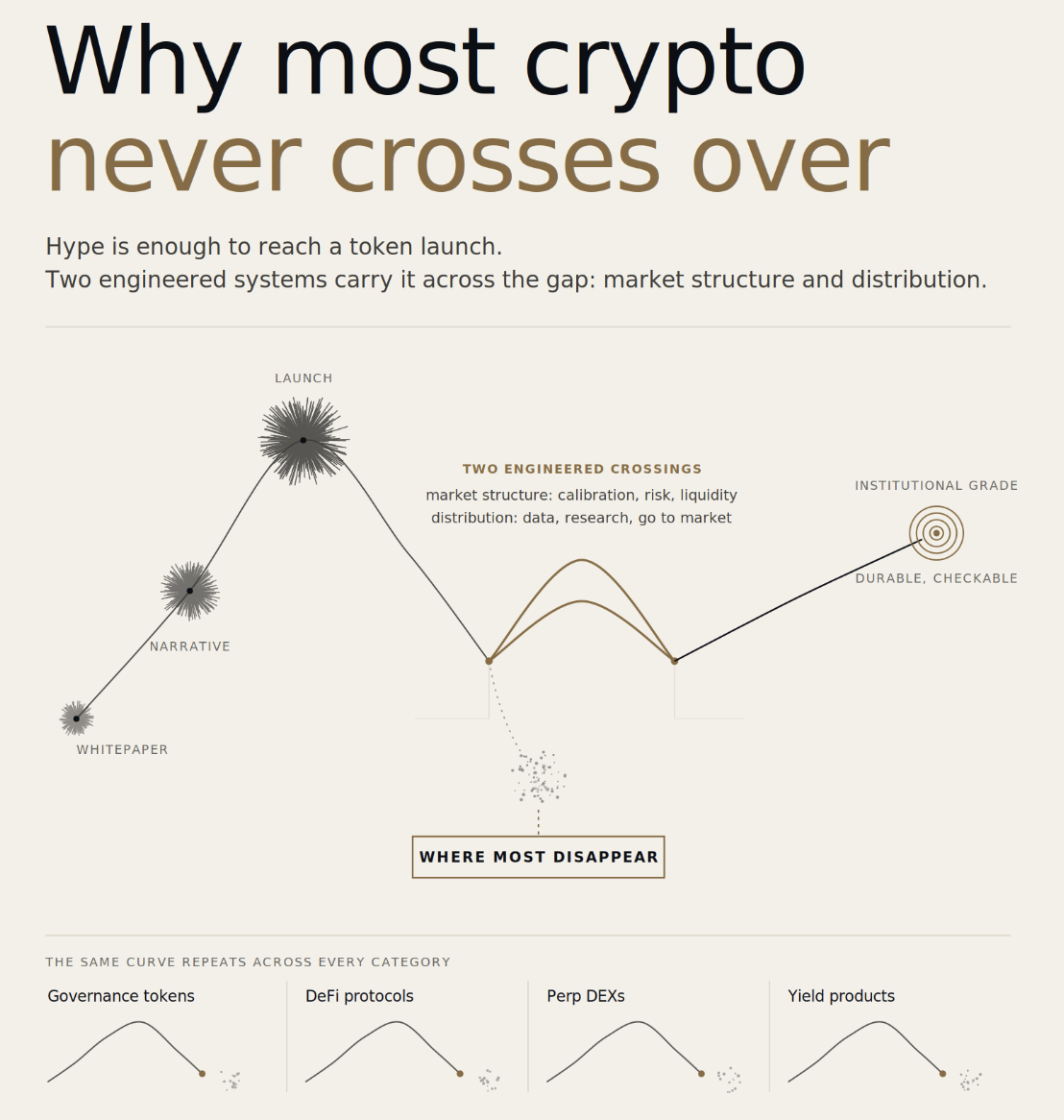
Figure 1. Hype is enough to reach a token launch. Two engineered systems, market structure and distribution, are what carry a project across the gap to institutional capital.
By 31 December 2025, more than half of every cryptocurrency ever launched had stopped trading. CoinGecko classified 53.2 percent of the tokens listed on GeckoTerminal as dead, roughly 11.6 million of them, with 86.3 percent of all recorded failures occurring in 2025 alone.
The fourth quarter accounted for about 7.7 million of those deaths, in the aftermath of the 10 October cascade that erased close to 19 billion dollars of leveraged positions in 24 hours, the largest single day deleveraging in the market's history.
The pattern is structural, not cyclical. When issuing a token costs almost nothing, most tokens are worth almost nothing. On Solana's dominant launchpad fewer than two in a hundred tokens ever graduated, and Solidus Labs classified 98.6 percent of them as rug pulls or pump and dump schemes, at issuance rates that approached 73,000 new tokens a day. The majority recorded no activity shortly after launch.
The death is not at the idea
The relevant question is not why most projects fail. It is why the survivors survive. On inspection the point of failure is rarely the concept. It is the interval between a launch that clears and a market that persists, where two conditions go missing. Either one is sufficient to end a project.
The first is users. Outside the twenty largest networks, most chains retain fewer than ten thousand daily users, and many fewer than one thousand. Polkadot, once positioned against Ethereum, records only a few thousand daily active addresses on Token Terminal, down from nearly twenty seven thousand at the end of 2022, and its monthly developer base has roughly halved since. Cardano sustains one of the higher developer outputs among Layer 1 networks yet supports 34 applications, against several hundred on Solana and more than a thousand on Ethereum, according to Moralis. Construction was never the binding constraint. Adoption was.
The second is a functioning market. A project can hold attention and still have no bid. Over the past year, protocols increasingly survived or failed on liquidity rather than on product. Absent a volatility surface a desk can quote, a risk framework a committee can approve, and depth sufficient to absorb a first drawdown, price formation halts and the asset is abandoned.
The crossing has two spans
Neither condition is resolved by further building. Both are engineered.
The first span is market structure: a calibrated volatility surface, a risk framework that holds under stress, and liquidity provisioning deep enough to survive an adverse session. This is the infrastructure that traditional finance developed over decades and that most crypto omits. The second span is distribution: the data, research, and go to market apparatus that converts issuance into genuine usage rather than passive holding. The first span makes an asset quotable. The second makes it demanded. Reaching institutional capital requires both.
The far side is no longer theoretical
As the failure rate rose, institutional allocation advanced. By late 2025, spot Bitcoin and Ether exchange traded funds held approximately 120 billion dollars and processed near 880 billion dollars in annual volume, a 37 percent increase on the prior year, according to The Block. Net inflows since the start of 2024 exceeded 57 billion dollars, and roughly a quarter of ETF holdings were institutional, capital that is benchmark driven and structurally slow to exit. Digital asset treasury vehicles raised a further 29 billion dollars over the year.
Tokenized treasury products passed 2.5 billion dollars within twelve months of launch. Estimates for tokenized real world assets range from 2 trillion dollars, per McKinsey, to as much as 30 trillion dollars by 2034, per Standard Chartered, characterised in one securities filing as potentially the largest capital migration in financial history.
The consequence follows directly. Institutional capital does not hold an asset it cannot price, and does not accumulate an asset without users. The gap in which most crypto dies is therefore the precise boundary between the token graveyard and the institutional balance sheet. The two spans that keep a project alive are the same two that render it investable.
The set of survivors is being fixed now
The market is consolidating. A single fund holds close to 60 percent of spot Bitcoin ETF assets. Developer activity is migrating out of the long tail toward the small number of ecosystems that have already established liquidity and usage. Consolidation is the ordinary behaviour of a maturing asset class, and it compounds. The set of assets that will carry institutional weight is being determined now, and the cost of entering it rises as it closes.
How SQV3 reads this
SQV3 works on both spans of the crossing. On the market structure side, calibration, risk, and liquidity, the machinery that lets institutional capital quote a token. On the distribution side, the data, research, and go to market engine that produces real users rather than passive holders. We treat each as an engineering problem with established methods rather than a matter of momentum.
Most crypto never crosses over because the crossing is rarely built. The projects that endure are not the loudest. They are the ones engineered to be priced and to be used.
Sources
Market data moves quickly. The figures above reflect late 2025 and early 2026 reporting and should be refreshed before republication.
- CoinGecko, dead token data, December 2025 (via BlockEden). https://blockeden.xyz/blog/2026/01/18/crypto-token-graveyard-11-million-failures-2025-memecoin-collapse/
- Solidus Labs, Pump.fun launch analysis (via BlockEden). https://blockeden.xyz/blog/tags/crypto/page/42/
- Token Terminal, Polkadot on chain metrics (via GN Crypto). https://www.gncrypto.news/learn/polkadot-dead-on-chain-metrics-dot-comeback/
- ETHNews, Polkadot developer and usage decline. https://ethnews.com/polkadots-downfall-explained-what-happened-to-the-once-promising-project/
- Moralis, Cardano application count (via AMBCrypto). https://ambcrypto.com/cardanos-ghost-chain-label-debunked-why-adas-34-dapps-dont-tell-the-full-story/
- Black Mountain Investment Group, active user distribution across chains. https://blackmountainig.com/ghost-blockchains/
- Cryptopolitan, developer migration and the primacy of liquidity. https://www.cryptopolitan.com/developer-activity-shifts-to-ethereum-solana/
- The Block, 2026 Institutional Crypto Outlook. https://theblock.co/post/382743/2026-institutional-crypto-outlook
- AMINA Bank, 2026 institutional adoption and market structure. https://aminagroup.com/research/2026-outlook-institutional-adoption-regulation-and-market-structure/
- BitGo Holdings Form DRS, tokenized treasury growth. https://www.sec.gov/Archives/edgar/data/1740604/000162827925000435/filename1.htm
- Real world asset projections from McKinsey, BCG and Standard Chartered (via SEC filing). https://www.sec.gov/Archives/edgar/data/2082542/000182912625009591/bitcoininfra_424b4.htm
Questions on the methodology, or a dataset you want run through it? We answer research mail.
amy@sqv3.com